
Roman Patrol Boats and Inland Navigation 50 BC to fourth Century AD (State: 28.03.2026)
The Fridericiana Alexandrina Navis (F.A.N.) was built in 2016/18 based on the model of the so-called Wreck II in Oberstimm near Manching (16 m long, 2.7 m wide), and the Danuvina Alacris was built between 2020/22 based on the model of Wrecks V and I from Mainz (18 m long, 2.8 m wide). These are not the first replicas of inland vessels that performed patrol duties, but–as things stand today–they are the ones that come closest to their historical models. Like the wrecks of Oberstimm, the F.A.N. is planked with pine using the mortise and tenon construction typical of Mediterranean shipbuilding, while the Danuvina Alacris is built in the so-called Gallo-Roman style, with oak planks and 4,000 iron nails, and is therefore twice as heavy (2.2 to 4 tons dry unloaded). This is important not only for the flow tests, especially since the encaustic ship painting (see below) documented for antiquity has been reconstructed for the first time: rather, the analyses regarding the durability of the boat are now also based on a historically sound foundation.

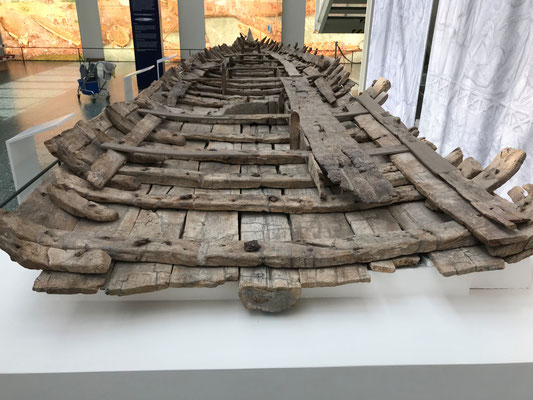

Figs. 1 and 2: left, wrecks I and II from Oberstimm (the F.A.N. was built after wreck II). Photo by A. Hilverda. Wrecks V and I of different but contemporary boats from Mainz (above and right) form the basis for the construction of the Danuvina Alacris. Photos by B. Dreyer.
Approximately 50 oars in alternative lengths (3.7, 4.1 and 4.7 m) followed, as did rudders, which are not documented on the originals but have been preserved either in contemporary finds or in other images. There are also yards, sprits and lateen sails in two fabric alternatives (linen and hemp) with 25 square metres each, for comparison purposes in the test.
One challenge associated with boats that represent completely different boatbuilding traditions is their long-term preservation. It seems that ships constructed using the Mediterranean mortise and tenon method are particularly susceptible to pests due to their construction. The shipworm (as in the case of the Olympias, a replica of a trireme) has so far spared the freshwater boat F.A.N. However, a fungus, the so called rusty-gilled Polypore (Gloeophyllum sepiarium) struck at the end of 2020, infesting about 30% of the pine planks.
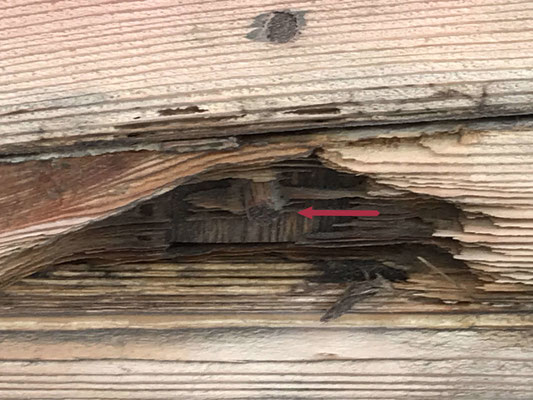
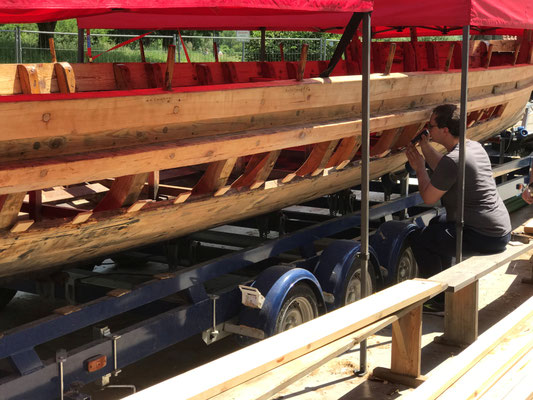
Figs. 3 and 4: on the left, the damaged pine wood (softwood parts eaten away), but underneath, the undamaged oak tenon and oak dowel can be seen (red arrow). On the right, the ship after removal of the damaged planks. Photos by B. Dreyer.
The fungus appears to have originated in the chiselled mortises where moisture had accumulated. The planks were laboriously replaced. Against the backdrop of this experience, the appearance of the planks from wrecks I and II from Oberstimm in the Celtic-Roman Museum in Manching (see above figure 1) could spark speculation about the reason for the abandonment of the boats at the end of the first century AD. The planks from wrecks I and II look remarkably similar to the pine wood from the F.A.N., which was damaged by fungal infestation. Dendrochronological dating of the planks used in wrecks I and II and the oak used to secure the wrecks in the riverbed of the Brautlach near Oberstimm proves that the boats were only used for a short time. After being abandoned, the wrecks were covered with screed to form the foundation of a wooden building in the civilian settlement that was built after the military withdrew. The planks of the F.A.N., which were infested, were examined in comparison with the planks of the originals. However, it remains unclear whether the infestation that decomposed the planks of the originals occurred before or after the sinking, albeit before the preservative sealing. Whether wrecks I and II were abandoned after pest infestation therefore remains open. The Danuvina, on the other hand, is more durable because of its oak planks, which contain the wood's own tannic acids. Furthermore, the described construction method in Gallo-Roman style without mortise and tenon joints does not provide any access routes for pests.
The tests were carried out immediately after completion of the Danuvina and repair of the F.A.N. at the beginning of July 2022 on the Altmühlsee and on the Danube – based on tests with the F.A.N. from 2018 to 2020. Since then, measurements to determine the performance spectrum of the boats have been carried out using refined research methods, instruments and objectives on calm waters and on the Danube (from Ingolstadt to the Black Sea) until the end of 2025, with a mixed group of rowers trained according to the specifications of sports scientists. The result of the test series is a differentiated picture of the performance of the Oberstimm and Lusoria types of boats. The project management was always accompanied by expert advice during all tests.
The F.A.N. was tested on a scale of 1:10 in the Erlangen water tank. According to the results, speeds of 4.4 knots under continuous load with 50 watts per rower (6.9 knots peak with 170 watts per rower) would be possible with the same load as in the 1:1 scale. According to the calculations of the fluid mechanics based on the model tests, the F.A.N. would be capable of a speed of about 6.3 knots and the Lusoria Danuvina of a speed of 5.8 knots. Does this reflect reality?
Previous reconstructions of the rowing apparatus on the Victoria (Hamburg/Haltern) and the Rhenana (Trier/Germersheim) have transferred modern rowing conditions to ancient ones. This means that the oars are fixed at a fixed angle during the rowing process. However, this does not correspond to historical conditions, as Bockius (2013, 37) has demonstrated using historical examples (wear marks on the tholepins in Oberstimm and Mainz and the example of Pisa nave C) and as we have also tested (figures 5 and 6). On this historical basis, all previous tests on other replicas (Victoria, Rhenana) with modern–fixed–suspension systems that mimic modern movement sequences are obsolete. We have been able to document that the effort required in the historical case is considerably greater, which is significant for the routine operation of the boats covering several dozen kilometres per day
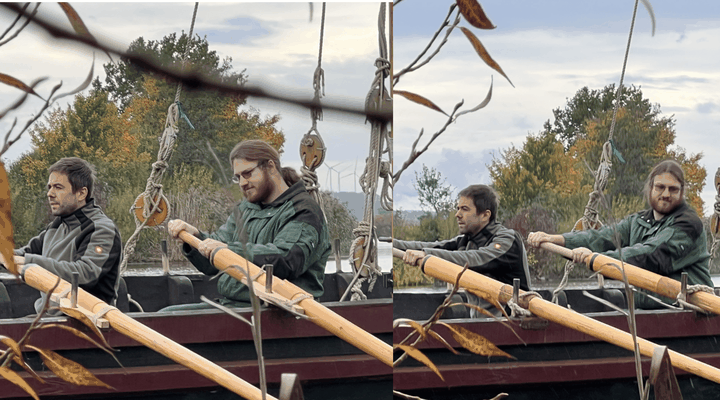
Fig. 5: The different belt suspensions are shown here: on the left, the fixed suspension of the oars used in the tests of the Roman boat reconstructions called Victoria and Rhenana, and on the right, the historical suspension (evidenced by abrasion at the tholepins of the boat wracks) with a rope ring (strope). Photos by B. Dreyer.
The oars were attached using a cardan joint, for example from the tholepin bowside, with a strope (rope ring). Although this attachment was less stable, it also had advantages: the rowers could determine the angle themselves according to their height and quickly retract the oars during amphibious operations. A defect (rope breakage or similar) did not halt rowing operations due to costly repairs on land.
Our team designed measuring devices especially for the tholepins (R. Fiedler) in order to quantify the power transmission and, based on this, the performance. The results show that the antique solid spruce oars (approximately 6.6 kg), which were not preserved for the boats but were replicated based on contemporary examples, enable the same power transmission (between 600 and 800 newtons) as with modern fibreglass or lightweight wood oar-versions (approximately 3.3 kg). But how will the use of historically connected oars affect sprinting or long-distance rowing?
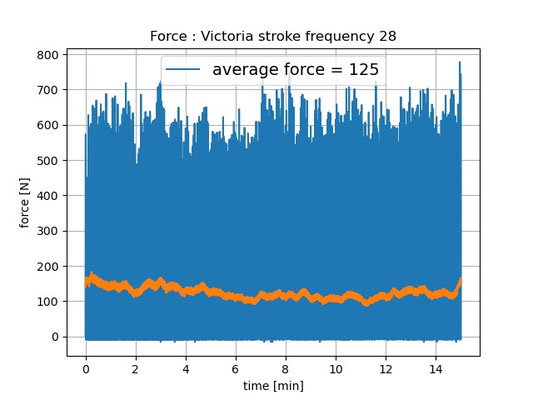
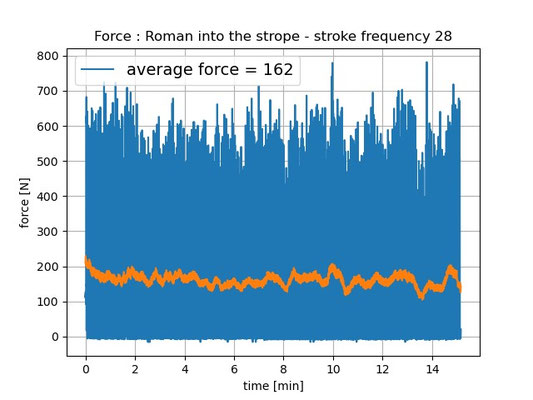
Fig. 6: The historical suspension system enables the same power transmission, but the effort required is considerably higher in the long term with the non-historical, fixed belt suspension system, as the diagrams show. Diagrams by M. Schedel.
Since the length of the oars has not been recorded, oars measuring 4.7, 4.1 and 3.7 metres in length have been compared to date. Rowing with shorter oars, which also provided more space inside the boat, especially in the bow and stern, and also allowed the boats to be used in narrow and small rivers, could be maintained for longer, up to 10 hours, and in shifts at an average speed of 3 knots (adjusted for current). Sprint tests in competition between the two boats show that speeds of around 4-4.3 knots are possible (confirmed by the sport physicians, with a rowing frequency of 30-33 strokes per minute). This is less than the theoretical calculations and tank tests on models have shown: probably a consequence of the fact that the weight of the oars, the distances between the rowers, the loose oar suspension and the wind resistance of the above-water boat take their toll in reality.
With a weight of 4-5 tonnes and 24 rowers, the Danuvina always has the advantage when a homogeneous team has gained speed. The advantages of the F.A.N. in sprinting are caught up with in a race at 600 m at the latest. On the other hand, the F.A.N. is superior to the Danuvina, which has a more angular design, in all manoeuvres and is more agile due to its better nautical chassis, which generates less frictional resistance–as Caesar (50 BC!) when comparing Roman and Celtic (sea-)boats (the latter continued in the Lusoria type (=Danuvina)) (De bello Gallico 3.13).
For the first time, the sails used in antiquity–spritsail, square sail, lateen sail in linen and hemp–were used for the two boats on a 1:1 scale: the six sails were reconstructed to cover 25 square metres. The originals certainly had one mast, albeit in the front third of the two boats from Mainz (Danuvina) and Oberstimm (F.A.N.), which was unfavourable for sailing. In relation to the length of the ship, the mast on the F.A.N. is historically 4.7 m behind the bow, and on the Danuvina 6.7 m behind the bow, for example well ahead of the respective lateral centre of gravity of the boats; the F.A.N. has a maximum draught of only 40 cm in the middle of the boat, while the Danuvina has a draught of about 40 cm over almost its entire length; there is no modern keel. In ancient times, there was considerable variation, as demonstrated by the coastal ship Pisa nave C, which, although constructed in the same way as the F.A.N., has a mast that is further back (approximately 1.5 m) in relation to the length of the boat. However, the tests must be conducted under the historical conditions of the boats from Oberstimm and Mainz.
The rudders can provide stability, and two alternatives (50 cm and 1.20 cm below the waterline) have been used based on ancient models (at the stern!). Plausibly, the deeper below water surface reaching rudders on the starboard and port sides guarantee greater course stability, but are not suitable for low water levels and small rivers, as was evident during the low water conditions on the Danube in 2022.
Improvements to the reconstruction of the F.A.N. are intended to improve the steering and sailing behaviour in a historically correct manner. This applies in particular to an additional rowing thwart instead of the nail board, and a modified rudder arrangement that increases steering power thanks to a longer blade, but does not exceed the deepest point of the boat due to its new and modified inclined position with at a slimmer angle, about 45 degrees, thus taking into account the conditions of amphibious combat missions. In addition, the rigging will be optimised and even the changed sailing behaviour due to the sail position will be tested in accordance with the identically constructed Pisa nave C.
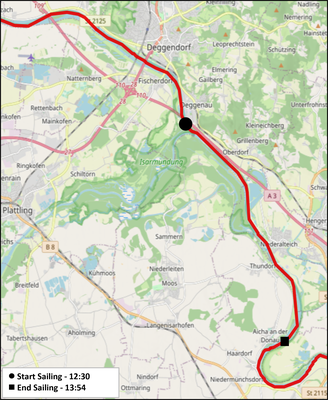
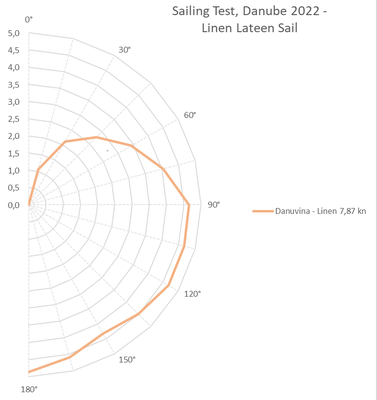
Fig. 7: On the left, the course of the Danuvina on the Danube downstream in 2022 with Latin sails and the polar diagram of the sailing tour for this stage (Stephansposching to Vilshofen), showing an excellent sailing behaviour of the Danuvina even in close upwind courses (but of course downstream, current velocity subtracted). Diagram by Th. Herder.
So far, it can be concluded that the Danuvina is best manoeuvred on a close reach using a linen lateen sail, particularly as the hull, with a draught of 40 cm along almost entire length of the boat, provides more course stability. Here, shifting behind the mast is also possible during every tack. In future, the mast is to be shortened further for this type of sail, which would allow the cumbersome shrouds to be dispensed with. This will enable the rapidly changing inland winds to be optimally converted into propulsion, even on the meandering ancient rivers–which in Antiquity were wider and flowed more slowly anyway.
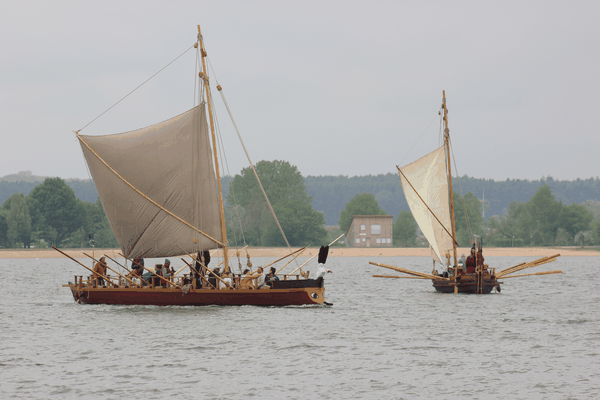

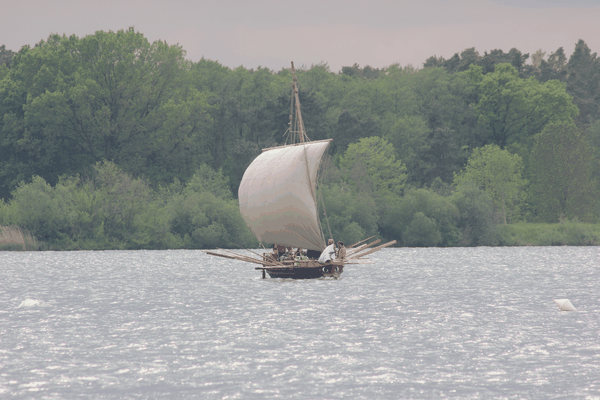
Figs. 8, 9 and 10: the boats with different sails, above the F.A.N. with lateen sail, in the middle Danuvina in front with sprit linen sail, in the background F.A.N. with sprit hemp imitating sail. Below the F.A.N. with square linen sail. Photos by A. Werner.
However, the F.A.N., which only reaches its maximum depth of 40 cm in the middle of the boat, copes better with the sprit sail due to the limited space in the bow. In the case of the lateen sail and the sprit, the wind pressure is further back in the boat and closer to the rudders at the stern, which provides course stability.
The square sail is the least favourable for both boats, even if you try to shift the wind pressure point aft using all the reefing options documented in antiquity. The leeway usually remains high when sailing close to the wind. However, it has also been documented that the course can be kept stable with the order allee the helm, while half of the rowing crew on starboard can take a break. Even with experienced skippers, it was not possible to tack through the wind unless the constellation was extremely favourable or only if the rowers on the leeward side assisted. The sailing performance of the F.A.N. improves the further the mast is moved aft. This can be demonstrated by setting the mast at the height at which it is documented on the identically constructed coastal ship from Pisa (Pisa nave C) with sails attached (Coates, McGrail, Brown, Gifford, Grainge, Greenhill, Marsden, Rankov, Tipping and Wright, 1995, p.298 on advantages of cost-saving reconstruction).
Overall, the Lusoria replica Danuvina has greater advantages for the range of applications in the region north of the Alps in linear border defence, as it was prevalent from the first century AD, especially from 260 onwards: It is easier to manufacture, the boatbuilding tradition is closer to home, and it is superior to the Oberstimm type in terms of sailing performance, durability (building material, see fungal infestation at the F.A.N.) and routine use for surveillance (downstream). These were probably the decisive reasons, proven by construction and testing, that led to the preferred construction of the Lusoria type in late antiquity. The F.A.N., which, according to the test results, is being further optimized according to historical standards like the Danuvina, was, on the other hand, ideally suited or better under ‘asymmetrical war conditions’ in Germania in the narrow river courses when the Roman Empire was on the offensive there on the small and winding rivers both east of the Rhine and north of the Danube (especially, but not only 12 BC-16 AD) and more agile and easily manoeuvrable ships were needed (success approved by Weski, 2025, pp.940-956).
Further Links
Videos about the construction and tests of the Danuvina and FAN to follow
Literature:
- Brechtel, F., Schäfer, Chr., Wagener, G., 2016. Lusoria Rhenana – ein römisches Schiff am Rhein. Neue Forschungen zu einem spätantiken Schiffstyp. Hamburg: Koehler Verlag.
- Bockius, R., 2013. Ruder-„Sport“ im Altertum – Facetten von Wettkampf, Spiel und Spektakel, Mainz: Verlag des Römisch-Germanischen Zentralmuseums.
- Preiß, B., 2022. Römische Flotten vor Friesland. Zu Landschaft, Schifffahrt und Geschichte der augusteischen Germanienkriege, Falkensee: Schwaigverlag.
- Rankov, B., 2012. Trireme Olympias. The Final Report. Oxford: Oxbow.
- Schäfer, Chr., 2008. Lusoria. Ein Römerschiff im Experiment. Hamburg: Koehler Verlag.
- Schäfer, Chr. and Aßkamp, R., 2008. Projekt Römerschiff. Nachbau und Erprobung für die Ausstellung Imperium, Konflikt, Mythos: 2000 Jahre Varusschlacht. Hamburg: Koehler Verlag.
- Weski, T., 2022. Segel, Takelage, Riemen. Zum Kenntnisstand antiker Schiffsausrüstung. In: B. Dreyer, ed., 2022. Ein Römerboot auf dem Prüfstand – Bau und Test für Wissenschaft und Öffentlichkeit. Darmstadt: WBG Academic. pp.190-221.
- Weski, T., 2014. Schifffahrt auf der Elbe und anderen mitteleuropäischen Gewässern. In: H.-J. Beyer and Th. Weber, eds., 2014. Altes und Neues - Vom Museum in den Landtag. Festschrift für Volker Schimpff zum sechzigsten Geburtstag. Beiträge zur Ur- und Frühgeschichte Mitteleuropas 76. Langenweißbach: Beier&Beran 2014.
- Weski, T., 2025. Navigare necesse est. Zu römischen Truppentransporten über das Mittelmeer. Münchener Beiträge zur Vor- und Frühgeschichte 70(2). pp.927-964.
- Whitewright, J., 2011. The Potential Performance of Ancient Mediterranean Sailing Rigs. International Journal of Nautical Archaeology 40(1). pp.2-17.
- Whitewright, J., 2018. Sailing and Sailing Rigs in the Ancient Mediterranean: implications of continuity, variation and change in propulsion technology. International Journal of Nautical Archaeology 47(1). pp.28-44.
- Roesdahl, E., ed., 1992. Wikinger, Waräger, Normannen. Die Skandinavier und Europa 800 – 1200. Ausstellungskatalog. Mainz: Verlag Philipp von Zabern.
- Dreyer, B., 2018a. Die Fridericiana Alexandrina Navis (F.A.N.) - Nachbau sowie wissenschaftliche Erprobung und Einordnung der Replik von Oberstimm II - Stand des Baus. Skyllis 17(1). pp.87-96.
- Dreyer, B., 2018b. Nachbau und Wissenschaft - die Fridericiana Alexandrina Navis (F.A.N.). Limes 12(1-2). pp.30-37.
- Dreyer, B., 2018c. Oberstimm: römisches Schnellboot kehrt zurück. Archäologie in Deutschland 4. pp.64-65.
- Dreyer, B., 2019a. Römerboote im Altmühlsee unterwegs. Bayerische Archäologie 3. pp.48-53.
- Dreyer, B., 2019b. The Fridericiana Alexandrina Navis. Rebuilding the past, improving Knowledge. Ancient Warfare 12(4). pp.51-57.
- Dreyer, B., 2021a. Ein neues römisches Donauboot wird gebaut. Das EU Interreg DTP Projekt ‘Living Danube Limes’. DI - Denkmal Information Bayern 176. pp.43-47.
- Dreyer, B., 2021b. Principles and Progress in the Shipbuilding Part of the Eu Interreg DTP Project ‘Living Danube Limes’. Akademieschrift: Bauwesen/Architektur 49. Budapest 2021, 171-208.
- Dreyer, B., ed., 2022a. Die Fridericiana Alexandrina Navis (F.A.N.). Ein Römerboot auf dem Prüfstand bei Bau und Test für Wissenschaft und Öffentlichkeit. Darmstadt: WBG Academic.
- Dreyer, B., 2022b. Bautagebuch für die F.A.N In: B. Dreyer, ed., 2022. Ein Römerboot auf dem Prüfstand – Bau und Test für Wissenschaft und Öffentlichkeit. Darmstadt: WBG Academic. pp.27-69.
- Dreyer, B., 2022c. Eine F.A.N.-Story – ein wissenschaftliches Abenteuer (2018 – Tagebuch), In: B. Dreyer, ed., 2022. Ein Römerboot auf dem Prüfstand – Bau und Test für Wissenschaft und Öffentlichkeit. Darmstadt: WBG Academic. pp.351-379.
- Dreyer, B. and Gatternig, B., 2019. A Scientific Adventure. Testing a F.A.N.-Theory. Ancient Warfare 13(2). pp.40-45.
- Kemmler, W., Dreyer, B. and Gatternig, B., 2022. Leistungsdiagnostik auf der Fridericiana Alexandrina Navis (F.A.N.) – eine Pilotstudie. In: B. Dreyer, ed., 2022. Ein Römerboot auf dem Prüfstand – Bau und Test für Wissenschaft und Öffentlichkeit. Darmstadt: WBG Academic. pp.482 - 498.
- Land, A. and Dreyer, B., 2022. Die römischen Feldzüge in Germanien und das Klima. Eine Fallstudie für die Jahre 15 und 16 n. Chr. In: B. Dreyer, ed., 2022. Ein Römerboot auf dem Prüfstand – Bau und Test für Wissenschaft und Öffentlichkeit. Darmstadt: WBG Academic. pp.515-530.
- Stamminger, M., Rückert, D., Gatternig, B. and Dreyer, B., 2022. Die F.A.N. virtuell besuchen und testen: Graphische Datenverarbeitung, Numerik und das Römerboot. In: B. Dreyer, ed., 2022. Ein Römerboot auf dem Prüfstand – Bau und Test für Wissenschaft und Öffentlichkeit. Darmstadt: WBG Academic. pp.499-514.
- Thünnesen, J., Gatternig, B., Günther, H.M., Wawrzyn, C. and Dreyer, B., 2022. Strömungsmechanische Tauglichkeitsanalyse der Fridericiana Alexandrina Navis (F.A.N.). In: B. Dreyer, ed., 2022. Ein Römerboot auf dem Prüfstand – Bau und Test für Wissenschaft und Öffentlichkeit. Darmstadt: WBG Academic. pp.431-481.
- Dreyer, B., 2024a. Zwei römische Boote im Test unter Riemen und Segel. Bayerische Archäologie 23. pp.52-55.
- Dreyer, B., 2024b. Zwei römische Boote im Test unter Riemen und Segel. Experimentelle Archäologie in Europa 23. pp.41-54.