
Roman Artillery: Torsion Guns, Onager, Bows and Arcuballistae (State: 28.03.2026)
Many torsions machines have been replicated with inconsistent results and inconclusive documentation. The guidelines presented here are rarely applied when replicating torsion guns from the early, middle, and late imperial periods and testing them under real conditions in accordance with the above-mentioned guidelines, which alone can provide essential insights into range, firing frequency, and accuracy. Beyond the individual cases of reconstruction to date, far-reaching conclusions about the performance of Roman artillery over time can be drawn. The late Republican/early Imperial torsion bolt weapon, the scorpio, was reconstructed based on the indestructible remains of a find in Ampurias, Spain, and with the help of the description by Vitruvius, a Roman architect during Caesar's time, in De Architectura (10.10.1), with a weight of 60 kg. The scorpio was a standard weapon used in fortresses and in the field (for example on carts = carroballista). According to Vegetius (2.25), each legion had about 55 of them (figure 11).

Fig. 11: The torsion weapon of the type scorpio. Photo by A. Hauenstein.
The model for the second torsion weapon (built in 2022) of the Orșova type (found in Romania on the Danube) weighing 80 kg was later put into use. Archaeological finds of this type of this weapon date from the second century (as confirmed by the reliefs on the Trajan's Column) to the fourth century AD. This cannon was also used in the field (see, for example, the battle of Harzhorn near Göttingen in 235 AD) and in fortresses (figure 12).
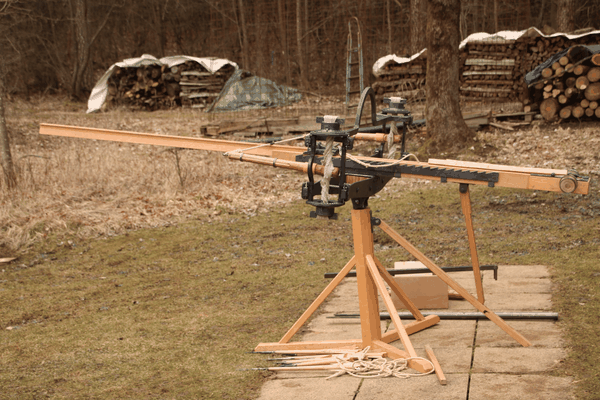
Fig. 12: The torsions weapon of the high imperial period onwards. Photo by A. Hauenstein.
The Romans did not invent these torsion catapults, which could fire both bolts and stones (weighing up to 90 kg) over long distances with great accuracy. From the beginning of the fourth century BC, development, supported by scientific research, reached its peak in the Hellenistic period (330 to 30 BC). The Roman “contribution” was the provision of these catapults in large numbers at a high technical level with unprecedented operational reliability. This is precisely what needs to be tested: frequency, accuracy, and range.
With practice, the torsion guns can be made ready for use in about 10 minutes; in the Roman legion, there were units responsible solely for ensuring operational readiness, even under enemy fire. The torsion bundles, the spring, consist of individual loops, as this makes them easier to replace. In the tests, 7 x 10 mm (=14 ropes) hemp loops were used in the older scorpio with a spring carrier height of 55 cm, and 10 x 8 mm (=20 ropes) loops were used in the later torsion weapon with a spring carrier height of 50 cm. Historical alternatives would have been horsehair or animal tendons. In fact, animal tendons are used for the draw: the tensile force on the homemade tendons of 8 individual strands twisted together (see below on arcuballista) is directly dependent on the weight of the torsion material in the spring carrier. In both cases, it was almost the same (210 g / 225 g). Due to its shorter range, the older (early imperial) scorpio fires faster than the younger (late antique) torsion cannon with two people as the gun crew. The reliable (!) frequency with a trained crew (2-3) is 12 shots per minute for the scorpio and 9 shots per minute for the younger, without compromising accuracy when preset. The average muzzle velocity of the 125 to 140 g iron-tipped bolts (modelled on the Dura Europos finds in Syria with three wooden fins) is 55 m/s for the scorpio and 77 m/s for the late antique torsion gun at full extension and, in the latter case, 170 kg pull weight. Used at Harzhorn in 235 AD, they explain the rapid success of the Roman troops, even though the Roman troops were at a disadvantage due to the surprise effect.
The onager, a catapult, was described in detail in Book 23 (chapters 4.4-6) by the bodyguard (protector domesticus) and historian Ammianus Marcellinus, who lived in the fourth century AD (figure 13). There are no other references to it apart from brief mentions by authors, and certainly no material remains. The onager is a single-armed catapult that fired stone balls at its target in area bombardments. The sling arm drew its acceleration power from a hemp torsion bundle. This catapult existed from the beginning and probably reached its peak in the fourth century AD.
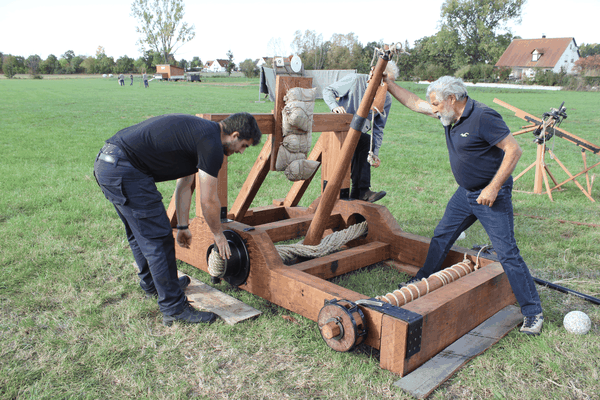
Fig. 13: FAU-onager. Photo by A. Werner.
Using the same text as a basis (Ammianus Marcellinus), Kayumov (2018) reconstructs a completely different version (figure 14).
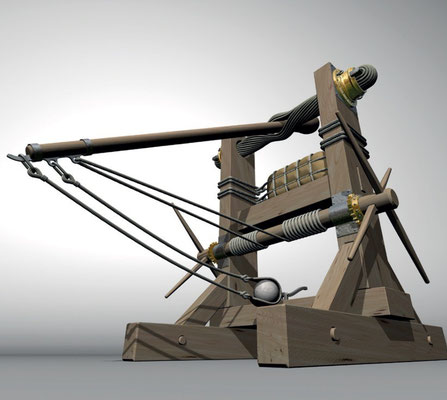
Fig. 14: 3 D-reconstruction of Kayumov (2018, p.570).
Kayumov's reconstruction is clearly based on the medieval trebuchet, in which the swing arm is accelerated and braked by a counterweight. In the onager, however, acceleration is achieved by torsion bundles. To understand the dynamics, the three most important phases of the movement are examined here: 1. Acceleration of the projectile by the throwing arm and sling. 2. Abrupt reduction of kinetic energy after the stone is released. 3. Parabolic flight of the projectile in the Earth's gravitational field.

Fig. 15: Schematic representation of the forces acting on the catapult. Drawing by R. Fiedler.
M=twisting moment of the rope package l2=length of the sling arm
l3=length of the sling m2=mass of the projectile
J=moment of inertia of the sling arm θ=angle of the sling arm to the x-axis
ψ=angle of the sling to the x-axis h=height of the axis above ground
The equation of motion, from which all relevant information can be derived, is now calculated by a Python programme that can be used to determine the physical variables and display them graphically. The example in figure 16 shows a simulation of the throwing range of the FAU onager with a drive torque of 5000 Nm (=Newton metres), a mass of 1.6 kg and an arm weight of 10 kg. The angular position of the arm at the start of the simulation is 0 degrees and that of the sling with the projectile is 90 degrees. In the simulation, the instantaneous velocity and trajectory angle of the projectile can now be determined for each point of the trajectory curve and the throwing distance can be calculated from this.
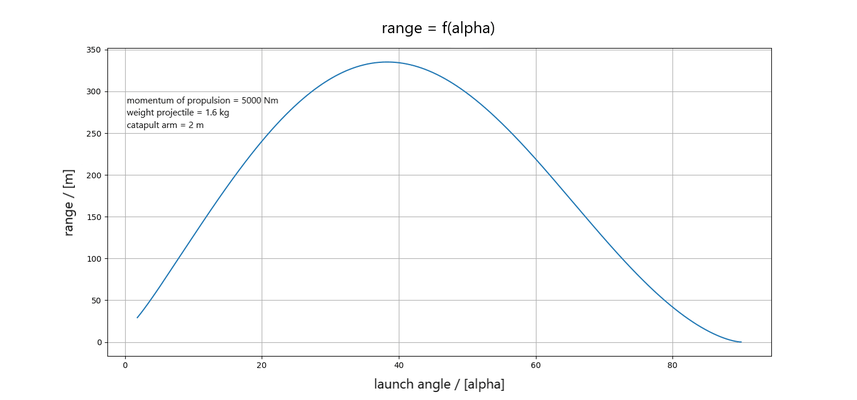
Fig. 16: Projectile range as a function of the angle of release. Diagram by R. Fiedler.
After release, the stored kinetic energy in the throwing arm must be dissipated in phase two–with high reaction forces on the onager. In the example above, with a drive torque of 5000 Nm, the arm's centre of gravity moves at around 100 km/h and has a kinetic energy (Ekin) of 3.1 kJ (kilojoules). As a simple approximation, a constant braking force over a specified distance is assumed. In the case of the FAU onager, braked with a 25 cm thick fur cushion, the acceleration is then 125 g (g-force), but this only acts over a period of 40 milliseconds. The resulting force is therefore F = 125 kN (kilo-Newton). This force acts on the centre of gravity of the throwing arm, which is determined by the height of the torsion bundle and the position of the centre of gravity of the throwing arm. With the high axis of rotation of the Kayumov variant, the resulting moment is three times higher. This must be counteracted by the design of the catapult at the outer fulcrum, for example a threefold increase in the load on the overall frame.
In phase three, the projectile moves freely in the Earth's gravitational field. The simulation shows (figure 17) that air friction and initial height play no role, whereas speed and launch angle determine the flight range.

Fig. 17: The distance achieved depending on the angle of 30, 45, 60 degrees (at 45 degrees with and without air resistance). Air resistance has little effect on the throwing distance, but the angle does. Diagram by R. Fiedler.
For the simulation, the same value was used for both variants (FAU-Kayumov):
| parameter | projectile arm | sling lenght | projectile mass | projectile arm mass |
| value | 2 m | 0.3 m | 1.6 kg | 10 kg |
The drive torque and the height of the torsion bundle were varied.
| variant | torque | torsion bundle height | height of release | projectile range max. | braking torque |
| FAU | 3000 Nm | 0.3 m | 1.3 m | 200 m | 80 kNm |
| FAU | 5000 Nm | 0.3 m | 1.3 m | 340 m | 125 kNm |
| Kayumov | 3000 Nm | 3.0 m | 4.0 m | 202 m | 240 kNm |
| Kayumov | 5000Nm | 3.0 m | 4.0 m | 342 m | 375 kNm |
On a full scale (FAU onager 500 kg), a granite ball weighing approximately 1.6 kg and a torsion tension of 24 × 20 mm hemp rope loops (48 ropes, 15 kg weight) a maximum of 7200, but usually less, and around 5000 newtons and a range of 150 m. The release angle was not 45°, as the screenshots of the experiments show.
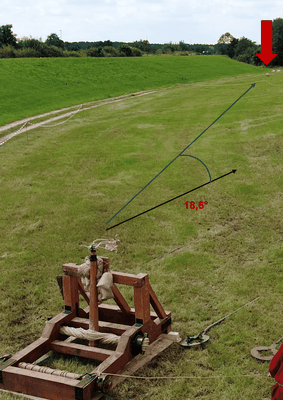
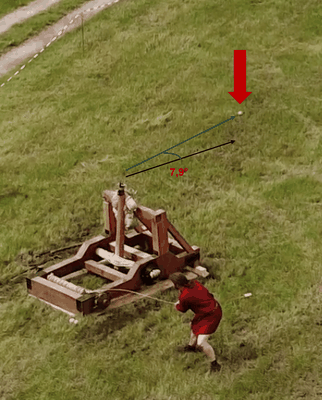
Fig. 18a and b: Empirical tests with FAU onager. Photos by B. Dreyer.
The results of simulations and empirical tests show that the increased drop has little effect on the distance, but a significantly more destructive effect on the construction. Here, the advantage lies in a reconstruction with low torsion. Kayumov's virtual reconstruction is therefore nothing more than a temporary solution, which may explain the rapid success of the medieval trebuchet, which is said to have come from the East (China).
The discontinuity in the usage of the complex and technically liable two-armed stone-throwers, that had dominated the centuries up to the third and fourth century AD, is not a sign for the decline in capabilities of the Roman troops. Vegetius described several torsion-engines but also ranged weapons that lay outside of this category: he describes Roman Bows and the arcuballista (Vegetius 2.15.7; 4.22.1; 4.22.7). Bows were used by specialised units, who had to practise their whole lives, and had always been used in auxiliary units of the imperial armies. Composite-bows were more common in the east for climatic reasons, while wooden bows dominated in the west.
Arcuballistae may not have been the characteristic ranged weapons of the Early Roman Empire but saw more widespread use in later times, when the fighting along the lines of demarcation became more fluid. The difference to earlier times lay in the fact that the limites functioned as a kind of trip-wire for the areas behind the frontier which were fortified with burgi. This required mobile units of cavalry and such, that were able to defend the burgi with ranged weapons whose use was easy to learn. A crossbow that separated the loading procedure from the process of shooting offered a solution. Thus, it offered certain advantages in sieges and naval warfare because the next shot could be loaded while taking cover.
The source situation considering the arcuballista is remarkedly bad–except Vegetius, but he did not describe the weapon in detail because he things it is known by everybody. Furthermore, it is shown on two reliefs from Gaul, that show the weapon in a context of hunting (figure 20), in the first century AD.
For our reconstruction of the arcuballista, methods of production had to be developed. Our bow-strings were produced with a simple technique and proved very stable and durable, already proved in the case of the torsions guns (above). At first, natural sinew was tested against artificial sinew regarding stretching properties of the material. After establishing the fact that natural sinew and artificial sinew behaved in the exact same way, we could rely on the much cheaper artificial sinew for further experiments. The production of bow-strings for the arcuballista was accomplished by evenly twisting the sinew-strings. Two wooden discs with holes were used for this process, with one fixed in position (figure 19). This made it possible to wrap six strings of sinew evenly around a core-string. The core consisted of two strings (in the aimed length, in our case of 116 cm) which was wrapped with six additional strings, twisted in opposite direction. Draw testing showed that the bow-string could tolerate a draw-weight of 168,5 kg.
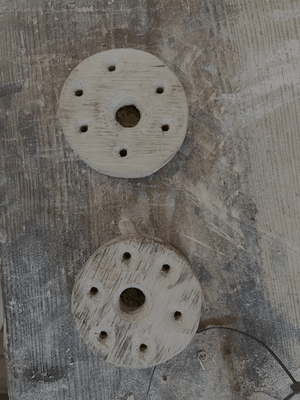

Fig. 19 (left): Pierced letters for making bow-strings. Photo by B. Dreyer.
Fig. 20 (right): Relief from Salignac (left) and Saint Marcel (right) (Espérandieu, 1908, pp. 442-444). 1679 (Salignac) and 1683 (Saint-Marcel)).
From the reconstructions of arcuballistae the prominent are the one by Baatz (1999), which has never been realized beyond drawings, and the reconstruction by Andreas Bichler, which used the drawings of Baatz.
Both reconstructions use the following characteristics:
- A wooden reflex-bow is rectangularly inserted in a wooden corpus.
- The wooden corpus makes the weapon heavy and unwieldy, if a kind of wood (like oak) is used that can deal with the high tension applied to it while loading and shooting.
- The bow-string chaves on the wooden corpus, even if the corners of the corpus are rounded out
- The bow-string is held in position by a nut (made of wood or bone) and released by a trigger underneath of the handle.
This form of arcuballista (figure 21) was reconstructed, with lighter pine wood. Anyway, the full wooden corpus is still heavy (3,6 kg), especially top-heavy (3,2 kg). This makes the fully loaded weapon very unbalanced. This contradicts the (later) development and logic of a crossbow, which usually aims at ease of use for the soldier

Fig. 21: Arcuballista made of pine wood, „traditional“ reconstruction using a nut (according to Baatz and Bichler, see above). Photo by B. Dreyer.
New approach: Christof Schindler and Wolfgang Wilsch went a step further (figure 22). A closer look at the reliefs (figure 20) demonstrates that the bow-string seems not to travel on top of the corpus but inside. The bow-strings travels much closer to the natural angle given by the positioning of the bow within the weapon, which strongly reduces the grinding of the string. This hollowed out construction also makes the weapon much lighter compared to a full wooden corpus. If the weapon is built like this, it becomes much easier to handle not from horseback, on foot, and behind fortifications because the arrow is fixed in place inside the corpus. The new approach also creates a weapon which is perfectly balanced, which increases the ergonomics (3.2 kg; 2.1 kg front weight in the case of the new oak replica). In the new version, the nut was relinquished and replaced by a simple hook, that is connected to the trigger. This simple change increases the drawing distance of the bow-string by 5 cm, which also increases the power of the shot in a machine that has the same dimensions as the “traditional” reconstructions by Baatz/Bichler.
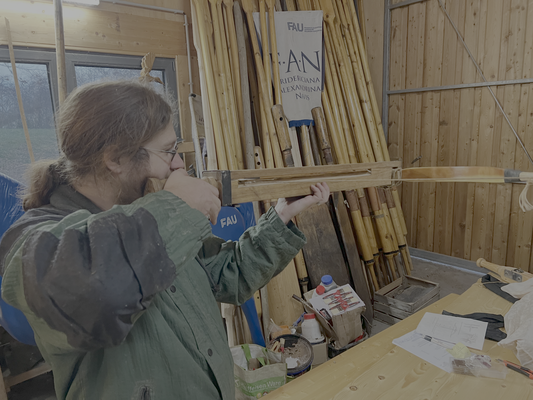
Fig. 22: Arcuballista, newly manufactured, made of oak and with a hook trigger. Photo by B. Dreyer.
In comparison to the bow (a Hungarian bow with 56 lbs draw-weight and an accordingly long arrow reached 55 m/s) the ‘traditional’ arcuballista (Type I) could reach speeds of 35-42 m/s, even if the wear and tear could be significantly reduced by rounding off the edges of the corpus, like in later medieval crossbows.
The newly constructed arcuballista (Type II) has almost the same draw-weight of 55,1 lbs. Both weapons can be shot at least 4 times a minute by a semi-trained operator. With the according training, eight shots are possible. The arrow travels with speeds between 50-51 m/s (180-183,6 km/h). This equals the results of the bow used without a wooden corpus – but anyone can do this, not only highly trained archers. This gives the arrow a theoretical reach of 260 m, if fired at an 45° angle.
Further Links
Videos about the Torsion Guns and onagers to follow
Literature:
- Baatz, D., 1999. Katapulte und mechanische Handwaffen des spätrömischen Heeres. Journal of Roman Military Equipment Studies 10. pp.5-19.
- Campbell, D.B., 2003. Greek and Roman Artillery 399 BC – AD 363. Oxford: Osprey.
- Gräf, St., Meißner, B., 2023. De Rebus Bellicis. Waffen und Finanzen in der Spätantike. Darmstadt: WBG Philipp von Zabern.
- Espérandieu, E., 1908. Recueil général des bas-reliefs de Gaule romaine, Volumde 2: Acquitaine 1908. pp. 442–444.
- Kayumov, I., 2018. Monagkon and Onager: A New Look at an Old Problem. In: C.S. Sommer and S. Matešić, ed., 2018. Limes XXIII. Proceedings of the 23rd International Congress of Roman Frontier Studies Ingolstadt 2015. Sonderband 4/1, Mainz: Nünnerich-Asmus Verlag. pp.565-573.
- Kayumov, I., 2022/2023. Some thoughts on the construction of the Roman scorpio of the Principate period. Journal of Roman Military Equipment Studies 23/24. pp.73-83.
- Marsden, E.W., 1971. Greek and Roman Artillery. Technical Treatises. Oxford: Clarendon Press.
- Neel, W. W., Hardin, J.-M., 2015. A Multidisciplinary Re-evaluation of the Fabrication and Operation of the 4th Century CE Roman Artillery Engine known as the Onager, American Society for Engineering Education, 1-21 [pdf]. Available through: semantic scholar <https://www.semanticscholar.org/paper/A-Multidisciplinary-Re-evaluation-of-the-and-of-the-Neel- Hardin/5eeb081ecc63dc673582d1ed807a6869f3fd42cb [Accessed: 20 March 2026].
- Saimre, T., 2006. TREBUCHET – A Gravity-Operated Siege Engine. A Study in Experimental Archeology. Estonian Journal of Archaeology 20(1). pp.61-80.
- Schramm, E., 1910. Griechisch-römische Geschütze. Bemerkungen zu der Rekonstruktion, Metz: Scriba.
- Schramm, E., 1916. Vom Onager. Zeitschrift für historische Waffenkunde 7/8. pp.231-233.
- Schramm, E., 1918. Die antiken Geschütze der Saalburg. Bemerkungen zu ihrer Rekonstruktion, Berlin: Weidmannsche Buchhandlung.
- Schramm, E., 1918. Μονάγκων und Onager. Nachrichten von der Königlichen Gesellschaft der Wissenschaften zu Göttingen. Philologisch-historische Klasse 1918. pp.259-272.
- Schwarz, R., 2015. Römerkastell Saalburg. Rekonstruierte Geschütze der Saalburg. Antike Artillerie. Bad Homburg v.d.H.: Nino Druck GmbH, Neustadt.
- Dreyer, B., Clement, P., Hauenstein, A., 2022. Ein spätrepublikanischer, frühkaiserzeitlicher Scorpio. In B. Dreyer, ed., 2022. Ein Römerboot auf dem Prüfstand – Bau und Test für Wissenschaft und Öffentlichkeit. Darmstadt: WBG Academic. pp.170-188.
- Dreyer, B., Hauenstein, A., Wilsch, W., 2023, In the Engine’s Sights. Testing Reconstructed Roman ballistae. Ancient Warfare 16(6). pp.26-19.
- Dreyer, B., Wilsch, W., 2024. Kicked by a donkey. The ‘Impact’ of the Roman Onager. Ancient Warfare 17(2). pp.8-11.
- Dreyer, B., Hauenstein, A., Wilsch, W., 2024. Im Visier römischer Torsionsgeschütze: Artillerie der Antike. Visier 2024(2). pp.78-81.
- Dreyer, B., Wilsch, W., 2025. Vom Skorpion gestochen – vom Wildesel getreten. Römische Artillerie im Test. Archäologie in Deutschland 2025(1). pp.46-49.
- Dreyer, B., Fiedler, R. Ein Wildesel als Mauerbrecher, Militärgeschichte. Zeitschrift für Historische Bildung [in print].