
Ancient Painting Techniques and Intended Effect (State: 28.03.2026)
It is now well established that antiquity was a colourful era, at least as far as the painting of durable materials is concerned (Brinkmann, 2003; 2010). The painting and dyeing of perishable materials has been far less thoroughly researched, but it certainly took place. To this end, the not infrequent but insufficiently utilised statements from written sources, alongside the few material remains, must be made fruitful and empirically reconstructed in terms of causal relationships. This is already yielding important results in the field of ancient encaustic and tempera techniques. In this way, gaps in our understanding can increasingly be filled:
a) Encaustic painting of ancient ships, in which the paint is burned onto the substrate (for example with wax as binder, applied as hot pigment-wax mixture), is only described by Pliny the Elder (Naturalis Historia 35.19-20; 35.31; 35.41, apart from a few material exceptions, such as the find in Pisa and Croatia, see above on ships). In many cases, it must be assumed that the natural paint has disappeared before excavations or that no search was made for its residues in the soil. It can be assumed that it was used on all ancient Roman ships, especially military ones, and served a representative, deterrent, but also, in the case of some types of ships, a camouflaging purpose, depending on strategy (Dreyer and Speck, 2021; Carbon, Dreyer and Speck, 2026).
b) The painting of ancient shields has only been handed down in fragments and by statements of authors such as Pliny the Elder and Vegetius. The most commonly used painting technique was tempera, in which pigments are applied to the substrate using water-soluble binders, usually lean, for example with a high proportion of aqueous and a low proportion of fatty substances. Animal glue was the most common binder, followed to a lesser extent by casein, egg and gum (and in some cases wax), as documented in ancient literature and also confirmed by art-technological examinations of painting residues. Within the EU Interreg-DTP project Living Danube Limes 20 Roman shields from around the third/fourth century AD with the motif–a Victoria with nimbus standing on a globe with a wreath in her right hand and a palm branch in her left–had to be built. A lime-casein tempera technique was used here, which required more layers of paint (primers and motif) and a high pigment content, but was very weather-resistant and easier to handle than animal glue tempera. Based primarily on the finds and the description of Polybios, we chose the ancient plywood technique for the construction. This means that thin strips of wood were glued together in layers, with the first layer aligned vertically, the second layer horizontally and the third layer again vertically. As in Dura Europos, we chose poplar as the type of wood (not birch as in Fayum attested) and shaped the shield convex and elliptic round (figure 35).

On the shape of a solid wood template (figure 34), on which the poplar strips were glued together. The glue was a mixture of curd (which contains natural casein) and slaked lime. The adhesive effect of casein and slaked lime was already known in ancient times.
Fig. 34: Shield template (massive pine) under construction. Photo by B. Dreyer.
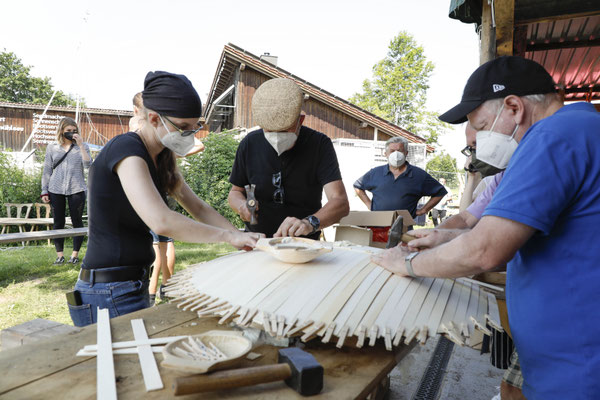
Fig. 35: First layer of poplar strips attached with clamps, the second and third with glue, temporarily fixed with little nails until the layers are dried out for a day. Photo by B. Dreyer.
Either linen (we used a density of about 500 g per square meter) or skin was applied with the same glue to the three layers, which held the shape of the solid wood negative in the dried state (curvature towards the centre 9 cm from the edge). The shield is secured at the edge with cowhide (cattle), which are sewn on and then left to dry.
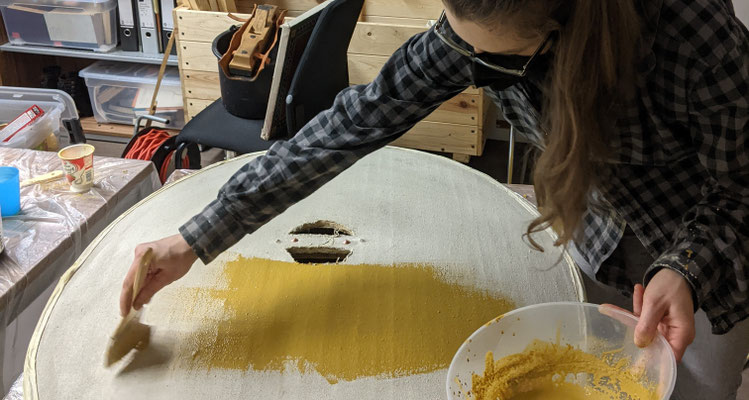
Fig. 36: The shield gets a hole in the middle, with later reinforced handle, the edge is secured by cowhide, then a ,primer’ is applied on both sides. Photo by B. Dreyer.
According to the findings (Nabbefeld, 2008), a hole with a handle (later reinforced) was dug in the centre, with a circular diameter of 12 cm flattened at the bottom. A brass boss with a rim of 4 cm and a curvature of 6 cm was attached to the shield torso with iron nails, which were subsequently cramped.
The painting was applied to the shield bodies in layers (figure 36, 37, 38): First a white layer (lime) was applied to the linen, then a yellow layer (yellow ochre). For the motif, the various pigments were mixed with a self-produced tempera (slaked lime, casein, water). The use of casein as a binding medium was known in antiquity (Pliny the Elder Naturalis Historia 36.177). The pigments used (for example various red and yellow ochres, green earth, lime, Egyptian blue, azurite and black from burnt wood) are all verified by ancient sources (Pliny the Elder, Vitruvius or Theophrastus).

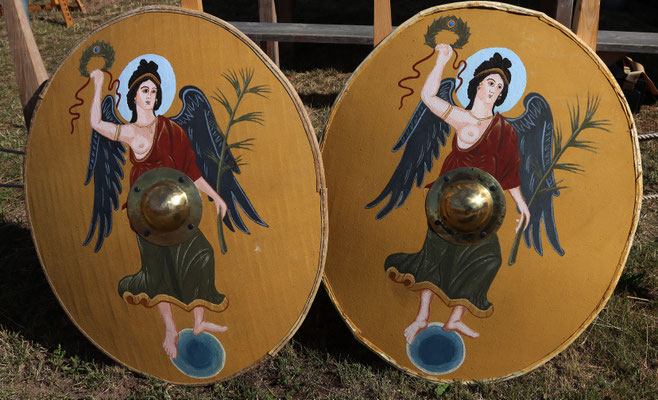
Fig. 37 (left): Work in progress: painting of the Victory’s skirt. Photo by B. Dreyer.
Fig. 38 (right): Two of the 20 shields finished. Photo by M. Orgeldinger.
The case of the binding media used for Roman shields remains unsettled, even after scientific analyses on the material remains (for example Gunnison, Passeri, Mysak and Brody, 2020). Therefore, as various binding media in Roman times are attested by ancient authors, the attempts to reconstruct ancient painting continued, with motifs historically attested (scutum of Dura Europos).
This time we tested animal glue as a binding medium (Pliny the Elder Naturalis Historia 28.236) in painting and as an adhesive (Pliny the Elder Naturalis Historia 7.198). The advantage was that this more easily soluble binder requires smaller amounts of pigment and previous layers of paint could be ‘softened’ and bonded with the (warm) next layer of paint. The disadvantage was that the pigment-binder mixture must always be applied warm (30-40°C). This required practice: After a first white layer with lime, a second layer of a red pigment (different variants) was applied. The motif elements of the scutum from Dura Europos were painted onto this second layer. According to the original an eagle stretching its wings standing on a globe and holding a garland in its beak. It is flanked on both sides by two Victories, each holding a wreath and a palm branch in their hands. In the lower third of the shield there is a lion whose body is painted in side profile, while the head looks out of the shield frontally. The basic colour of the lion is a yellow-brown. The colour is based on the recipe of Vitruvius (7.14.1): coloured water of boiled yellow violets and lime. For the different shades, a small amount of yellow-brown base colour was mixed with green earth and with red ochre and ground carbon black. Marble flour was used for the white highlights (also for the victories and the eagle). The base colour of the eagle and the two Victories is made from yellow ochre and marble flour – except for the flesh tone of the Victories, where ground yellow marble was added to the aforementioned ochre-marble mixture. The shades of the were painted using green earth, red ochre mixed with a little ground carbon black and indigo. The ornaments grouped around the shield boss were painted with the same pigments, except that no pigments were mixed together here–except for the spiral meanders: here yellow ochre was mixed with a little marble flour (figure 39).

The use of animal glue has the following advantages over casein for the shields: 1) The pigments can be applied over a thinner area. 2) Green earth (which could not be painted with thin brushstrokes) as well as lime and marble flour, which were difficult to apply with the lime-casein mixture, could be painted very well in animal glue, which also facilitates (and in some cases enables) finer detailing. 3) Due to the consistency of the animal glue-pigment mixture, it is possible to level out unevenness in the shield body and the covering by applying layers of primer, so that an even painting surface is created even with a wide-textured canvas, for example. 4) Due to the solubility of the animal glue on contact with warm liquid, the different layers of colour can bond with each other, which prevents flaking, especially of primer layers that even out unevenness. 5) Despite its general solubility in water, initial tests on painting samples have shown that animal glue is unexpectedly stable in cold water.
Other tests on alternative attested binding media (mixtures) have to follow to identify the advantages of the respective recipes for the various transient colour carriers.
Fig. 39: painted shield with animal glue based on the motive of the scutum from
Dura Europos. Photo by Chr. Sponsel-Schaffner.
It has long been known that antiquity was colourful. The field of perishable materials and their painting is still largely unexplored and yet important - as the example of ship and shield painting shows: Painting served the purpose of identification and at the same time had to be durable. If the comparatively numerous ancient statements on painting and scientific analyses of the few material records do not allow any clear statements to be made, experimental reconstruction work must be carried out: A difficult but commendable task.
c) Painting the Roman travelling carriage.
The increasing skills in painting imperishable materials had profitable cross-effects when painting the linen side coverings of the carriage (see above). The red primer on the linen coverings, on both sides, was applied according to the experience with shields based on the motifs of the scutum from Dura Europos. This also applied to the eagle, using an adapted, in this case lime-casein-tempera technique (with reduced layers of paint, with lower pigment content in the binder mixture, and without the use of oil), because the paint on the linen had to be both flexible and water-resistant without losing depth (shading). It can be said, that different materials require different skills in the range of Tempera-painting (Sponsel-Schaffner, 2024). Effect criteria (recognizability, psychological effect) could be tested empirically. But the painting also has a protective function. The cooperation between ancient history, chemistry, and perception psychology led to new insights regarding the targeted use of colours and painting techniques to achieve the desired effect (such as liveliness), which can also be transferred to other applications.
Further Links
Literature:
- Brinkmann, V., 2003. Die Polychromie der archaischen und frühklassischen Skulptur. Studien zur antiken Malerei und Farbgebung, Volume 5. München: Biering & Brinkmann.
- Brinkmann, V. and Scholl, A. eds., 2010. Bunte Götter: Die Farbigkeit antiker Skulptur. Eine Ausstellung der Antikensammlung, Staatliche Museen zu Berlin in Kooperation mit der Liebieghaus-Skulpturensammlung, Frankfurt am Main, und der Stiftung Archäologie, München, im Pergamonmuseum auf der Museumsinsel Berlin, 13. Juli - 3. Oktober 2010. Berlin: Hirmer.
- Brinkmann, V., Primavesi, O., Hollein, M., eds., 2010. Circumlitio. The Polychromy of Antique and Medieval Sculpture. München: Hirmer.
- Carbon, C.-C., 2022. Über die Wahrnehmung und Wirkung von Römerbooten: Zwischen Camouflage, Überraschung und Terror. In B. Dreyer, ed., 2022. Ein Römerboot auf dem Prüfstand – Bau und Test für Wissenschaft und Öffentlichkeit. Darmstadt: WBG Academic. pp.333-349.
- Dreyer, B. and Speck, M., 2021. Farbe und Intention. Rekonstruktion antiker enkaustischer Bemalung auf der F.A.N. und DANUVINA ALACRIS. Skyllis 21. pp. 62-71.
- Carbon, C.-C., Dreyer, B. and Speck, M., 2026. Using perception as a strategy: Camouflage, surprise, and the moment of shock related to perception. I-Perception 17(1). pp.1-7. https://doi.org/10.1177/20416695261425471.
- Goethert, K. P., 1996. Neue römische Prunkschilde. In: M. Junkelmann, ed. 1996. Reiter wie Statuen aus Erz, Mainz: von Zabern. pp.115–126.
- Gunnison, A., Passeri, I., Mysak, E. and Brody, L.R., 2020. Painted Roman Wood Shields from Dura-Europos. In: M. Svoboda and C.R. Cartwright, eds. 2020. Mummy Portraits of Roman Egypt. Emerging Research from the APPEAR Project. Los Angeles: Getty Publications. pp.139-141. Available at: <https://www.getty.edu/publications/mummyportraits/downloads/SvobodaCartwright_MummyPortraits.pdf.> [Accessed 19 March 2026].
- Nabbefeld, A., 2008. Römische Schilde. Studien zu Funden und bildlichen Überlieferungen vom Ende der Republik bis in die späte Kaiserzeit. Rhaden/Westfahlen: Leidorf.
- Sponsel-Schaffner, Chr., 2024. Painting Techniques for Roman Shields. Per Aspera ad Astra. Ancient Warfare 17(5). pp.48-49.